































Mulga, the strongman of Australian timber

Flickr photo by Starr Environmental shared under a Creative Commons (BY) license
Mulga (Acacia aneura) is one of the toughest native timbers found in Australia’s arid interior. Growing in some of the driest regions of the continent, it produces a dense, hard wood that is valued for strength and durability under demanding conditions.
What Makes It Different
Mulga is extremely dense and hard, with a tight grain that resists wear and impact. Its strength is not just theoretical, it is a timber that holds up under repeated use, pressure, and exposure.
The wood ranges from deep red-brown heartwood to lighter sapwood, often with a subtle natural lustre. While it can be worked and finished cleanly, its defining characteristic is durability rather than ease of handling.
How It Was Used
Mulga has long been used by Indigenous Australians for tools, weapons, and implements where strength was essential. It was also used for posts and structures, particularly where timber needed to withstand ground contact and harsh conditions.
What Changed
Modern use has shifted away from large structural applications toward smaller objects, where the timber’s density and durability can be used more directly.
How It Is Used Now
Mulga is well suited to items that are handled frequently and expected to last. Its density gives weight and resistance to wear, making it particularly effective in tools and functional objects.
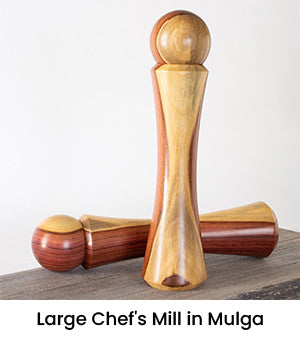
Kitchen mills are a practical example. These rely on a stable, durable timber that can withstand repeated handling without wearing down or losing form.
Browse our range of Mulga pieces, including items designed for regular use.

Mulga is defined by strength. It is a timber that performs under pressure, which is why it has been relied on across both traditional and modern uses.