An end grain chopping board is made so that the ends of the timber fibres form the cutting surface. An edge grain board, by contrast, presents the long sides of those fibres.
What Is an End Grain Chopping Board?
Wood is made largely from elongated cells arranged along the length of the tree. The USDA Forest Products Laboratory describes wood as a material whose structure and properties vary according to direction.[1]
When timber is cut across those cells, their ends are exposed. This transverse surface is known as the end grain.
On an end grain cutting board, multiple pieces of timber are arranged with these transverse surfaces facing upwards. This produces the block-like, chequered or mosaic appearance associated with many end grain boards.
An edge grain board instead presents the longitudinal surface of the timber, so its grain usually appears as longer lines or strips.
How Are End Grain Chopping Boards Made?
One established method begins by joining lengths of timber into a panel. The panel is then cut across the grain into strips, the strips are rotated so the end grain faces upwards, and the pieces are arranged and glued together again.[2]
More elaborate designs can require additional cutting, pattern alignment, glue-ups, flattening, sanding and finishing.
End Grain vs Edge Grain Chopping Boards
| Feature |
End grain |
Edge grain |
| Cutting surface |
Ends of the timber fibres |
Long sides of the timber fibres |
| Typical appearance |
Blocks, squares or chequered patterns |
Longer grain lines or timber strips |
| Construction |
More complex |
Simpler |
| Manufacturing |
More cutting and assembly stages |
Fewer assembly stages |
| Price |
Usually higher |
Usually lower |
| Care |
Requires normal wooden board care |
Requires normal wooden board care |
Are End Grain Chopping Boards Better for Knives?
End grain boards are often described as being gentler on knife edges because the blade meets the exposed ends of the timber fibres rather than repeatedly cutting across their long sides.
You may also see end grain described as “self-healing”. Timber does not literally repair itself after being cut. The term refers to the way the fibre orientation can make fine knife marks less conspicuous on some end grain surfaces.
While woodworkers and manufacturers widely describe end grain as knife-friendly, direct comparative research quantifying whether knives stay sharp longer on end grain than on an otherwise comparable edge grain wooden board is limited.
Why Are End Grain Chopping Boards More Expensive?
End grain boards generally cost more because their construction requires additional machining, assembly and finishing compared with a simpler edge grain board.[2] More elaborate patterns can add further work, so the price reflects both the timber and the more involved construction.
What About Hygiene?
The available hygiene research largely compares wooden chopping boards with plastic rather than end grain with edge grain, so it should not be used to claim a hygiene advantage specific to end grain construction.
In experiments published in the Journal of Food Protection, Ak, Cliver and Kaspar applied Escherichia coli, Listeria and Salmonella to wooden and plastic cutting-board materials. Bacteria were generally recovered in lower numbers from the wooden samples, with clean wood rapidly absorbing the applied liquid.[3]
A later study comparing hardwood and polyethylene boards found no significant difference in bacterial levels after contact with ground beef. Washing removed most bacteria from both materials, and the researchers emphasised the need for proper sanitation regardless of board composition.[4]
A 2025 study comparing sugar maple with high-density polyethylene found that detectable E. coli on maple declined significantly to the study's detection limit after two hours, even without cleaning. Staphylococcus aureus declined more slowly, while cleaning significantly reduced bacterial counts on both maple and plastic boards.[5]
These findings do not support treating wooden chopping boards as inherently unhygienic simply because wood is porous. They also do not mean that a wooden board sanitises itself.
The NSW Food Authority advises that cutting boards should be thoroughly cleaned, that equipment used for raw food should be kept separate from ready-to-eat food or properly cleaned and sanitised between uses, and that badly cut or gouged boards should be replaced if they can no longer be effectively cleaned.[6]
Australian Timbers in Our End Grain Chopping Boards
Our end grain range includes Huon Pine, Golden Sassafras, and a combination of Jarrah and Golden Sassafras.
Huon Pine
Tasmanian Timber describes Huon Pine as having a fine, even grain, rich golden colouring and a natural preserving oil with a distinctive scent.[7]
Golden Sassafras
Tasmanian Sassafras is available in two major groupings: Golden Sassafras and Blackheart Sassafras.
Golden Sassafras is the lighter material, with pale creamy, grey and golden tones, while Blackheart Sassafras develops distinctive dark streaking. Tasmanian Timber describes Sassafras as light, strong, relatively soft and readily workable.[8]
Jarrah
WoodSolutions describes Jarrah as an Australian hardwood whose heartwood ranges from rich reds to browns. It lists a seasoned density of approximately 820 kg/m³ and a seasoned hardness of 8.5 kN.[9]
Our End Grain Chopping Boards
Our end grain chopping boards are handmade from Australian timbers and conditioned with food-safe mineral oil and beeswax.
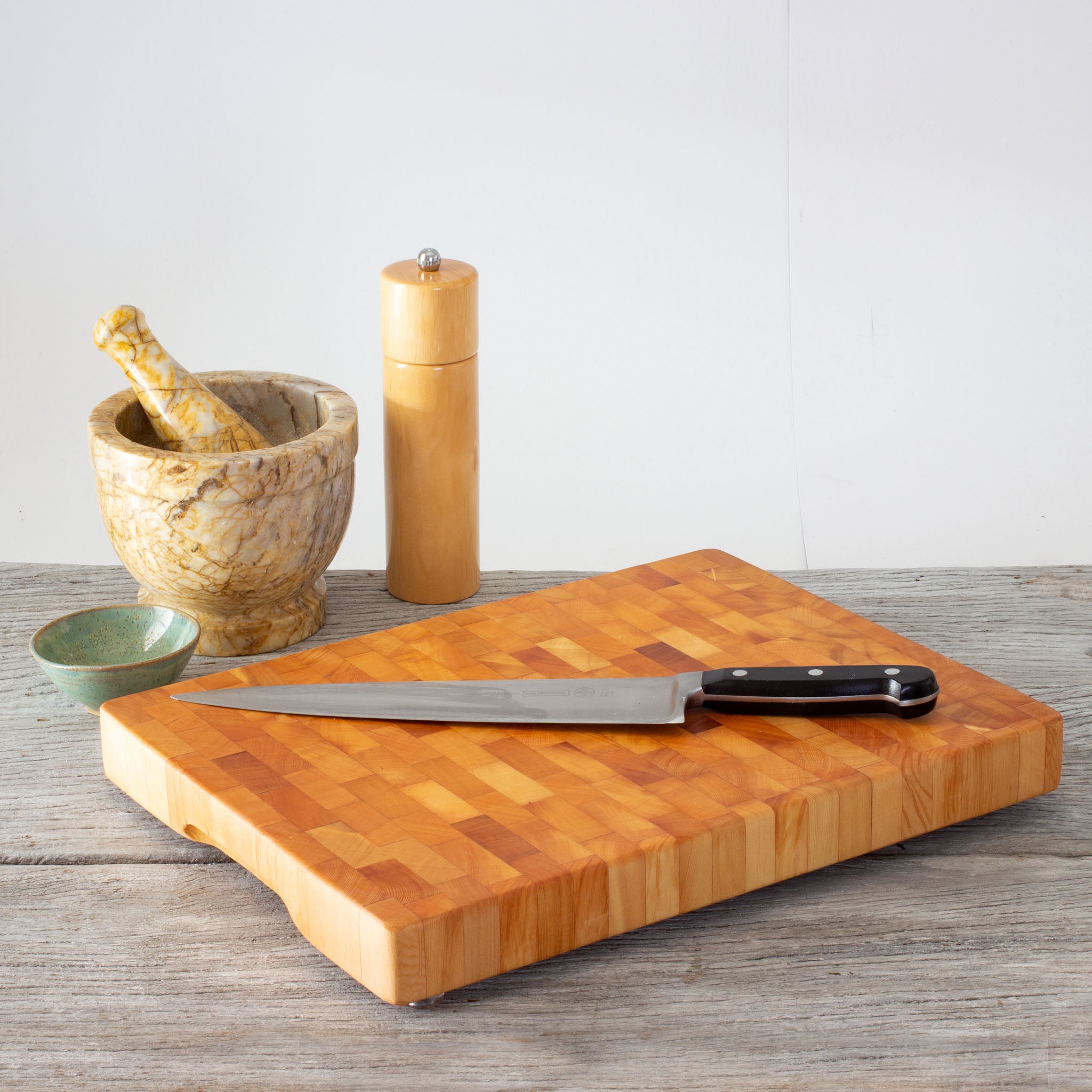
Made entirely from Tasmanian Huon Pine, this board is available in three sizes: approximately 30 × 40 × 4 cm, 30 × 45 × 4 cm and 30 × 50 × 4 cm.
Feet raise the board slightly from the kitchen bench, helping air circulate underneath as it dries after cleaning.

This Golden Sassafras board measures approximately 30 × 45 × 4 cm.
Finger grooves at either end make the board easier to lift, while raised feet provide clearance from the bench as it dries.

This board combines darker Jarrah with lighter Golden Sassafras in a contrasting chequered pattern.
It measures approximately 30 × 40 × 4 cm and includes finger grooves and raised feet.
How to Care for an End Grain Chopping Board
For our oil-finished kitchen boards, we recommend:[10]
- washing the board by hand with warm water and a small amount of detergent when necessary
- not leaving it soaking in water
- avoiding the dishwasher
- allowing it to dry thoroughly
- keeping it away from prolonged direct heat
- reconditioning the timber when the surface begins to look dry
- following appropriate food-safety practices when preparing raw meat, poultry or seafood
- replacing the board if deep cuts or gouges prevent it from being cleaned effectively
Is an End Grain Chopping Board Right for You?
An end grain board may suit you if you want a substantial wooden preparation surface, like the distinctive block-pattern appearance and are comfortable periodically maintaining an oil-finished timber board.
An edge grain board may be the more practical choice if you want a simpler, generally less expensive wooden board and the appearance of end grain construction is not important to you.
When choosing between them, consider the dimensions and weight of the particular board, your available bench space, your budget, the timber you prefer and the maintenance involved.
References
- Wiedenhoeft, A. C., & Eberhardt, T. L. (2021). Structure and function of wood. In Wood Handbook: Wood as an Engineering Material. USDA Forest Service, Forest Products Laboratory. View source
- Brower, J. (2022). Make mosaic cutting boards. Fine Woodworking, Issue 294. View source
- Ak, N. O., Cliver, D. O., & Kaspar, C. W. (1994). Cutting boards of plastic and wood contaminated experimentally with bacteria. Journal of Food Protection, 57(1), 16–22. https://doi.org/10.4315/0362-028X-57.1.16
- Miller, A. J., Brown, T., & Call, J. E. (1996). Comparison of wooden and polyethylene cutting boards: Potential for the attachment and removal of bacteria from ground beef. Journal of Food Protection, 59(8), 854–858. https://doi.org/10.4315/0362-028X-59.8.854
- Bischoff, A., Alter, T., & Schoenknecht, A. (2025). Hygienic evaluation of wooden cutting boards: Microbiological parameters. Journal of Food Protection, 88(9), 100576. https://doi.org/10.1016/j.jfp.2025.100576
- NSW Food Authority. Cutting and serving boards. View source
- Tasmanian Timber. Huon Pine. View source
- Tasmanian Timber. Sassafras. View source
- WoodSolutions. Jarrah. View source
- Australian Woodwork. Looking after your woodwork: A care and maintenance guide. View our care guide


